
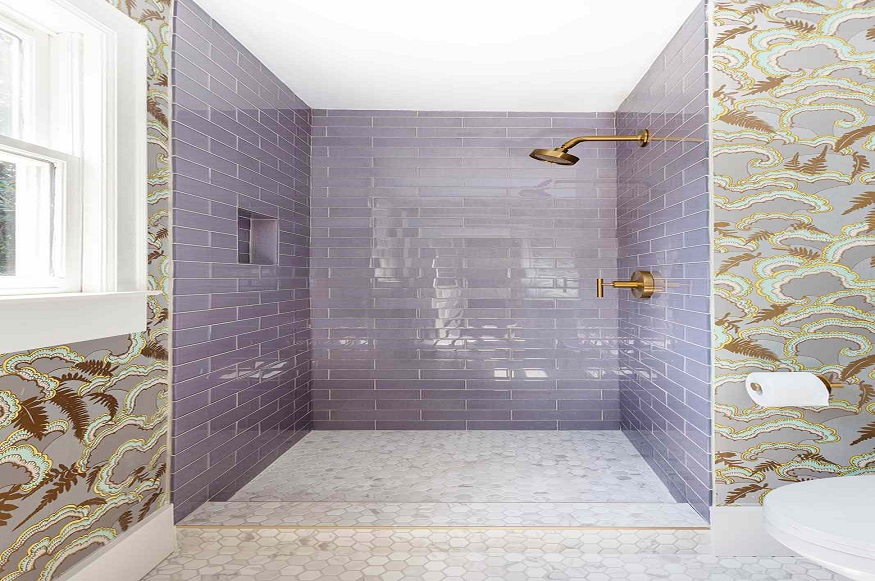
The walk-in shower has become popular. The minimalist aesthetic draws many homeowners. However, you can’t just do away with the tub, put up some glass, and call it a day.
A good design calls for more forethought. If you don’t attend to the details at the outset, what should be a functional space will only end up as a nuisance.
Start by planning the drainage and slope
This has to be done before anything else. Remember, there is no curb or barrier to hold water back. So, your floor has to be sloped correctly to guide it to the drain.
The type of drain you go with will dictate the work required. A linear drain, for instance, is well suited to larger shower tiles set on a single, easy gradient. Put in a central drain, and you will likely need smaller tiles. They should be placed in a radial pattern to get even drainage from all sides.
Read More: The Benefits of Internal Signage for Your Business
Make a misjudgment here, and you are left with a floor that won’t dry off and pools of water.
Know how much containment you really want
Walk-in showers vary significantly. Mostly in how much they contain water within the shower zone.
Some walk-ins are fully open. They have no glass panel, creating an open and airy look. That demands high waterproofing and drainage over a wider area of the floor.
If you want to keep things open, consider:
- Ascreen
- A partial panel
This is a good compromise. It will still stop the splashing.
Don’t skimp on waterproofing
With a traditional enclosure, you have a basin to contain things. With a walk-in, you don’t. That makes it all the more important to seal the walls and floor properly.
A weak spot in the membrane means water will eventually find its way into the subfloor or walls. You’ll be looking at costly repairs down the road. You cannot afford to cut corners here.
Be realistic about the square footage
A walk-in shower generally needs more floor space. This is necessary for:
- The space to feel comfortable
- To allow water to be properly contained without a door or curb
Don’t force the design into a small bathroom. Otherwise, the layout will be constricting. Even frustrating, the water will spread.
Read More: Mediterranean Backsplash Ideas for a Cozy Cooking Area
Measure the space and run it by a designer. Be sure that the concept fits the dimensions before you go ahead with it.
Then there is the question of privacy
You can see right into a walk-in shower from the rest of the room. Unless you put a wall or door in the way. That can be an issue, depending on who is using the bathroom and how it is laid out.
To solve this, you can:
- Position the shower so it is not in plain view from the door
- Use frosted glass or a half wall
That way you preserve the appeal of the open design while maintaining some privacy.
Final words
A walk-in shower makes a bathroom elegant and truly modern. But only when the underlying planning is done well. Take the above factors into account before selecting any surface finishes. You want the finished product to be both aesthetically pleasing and functional.